
Interesting Facts About Learning Disorder
Learning disorders are more common than many realize, yet they remain misunderstood. In psychology, these conditions affect how individuals acquire, process, and use information. Understanding what a learning disorder is and its types in psychology is essential for professionals, students, and educators who want to support diverse learners effectively.
🌟 What is a Learning Disorder?
A learning disorder is a neurological condition that impacts a person’s ability to read, write, speak, or perform mathematical calculations. Unlike intellectual disabilities, learning disorders do not affect overall intelligence. Instead, they interfere with specific skills, making everyday academic tasks more challenging.
📚 Types of Learning Disorders in Psychology
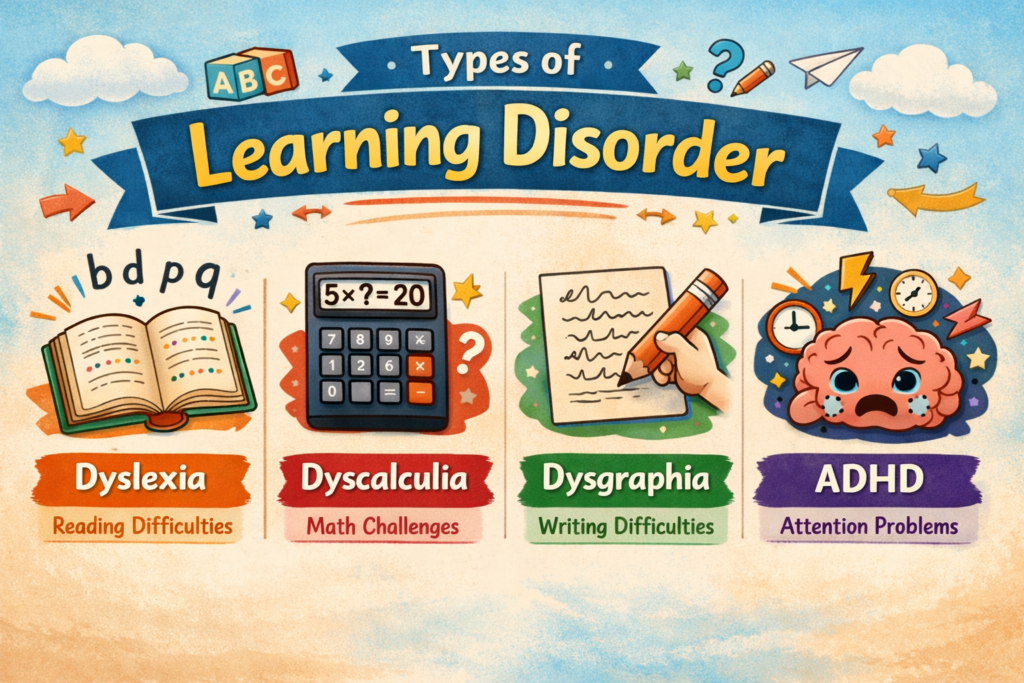
Dyslexia
Difficulty with reading and language processing.
Individuals may struggle with word recognition, spelling, and comprehension.
Dysgraphia
Impacts writing ability.
Symptoms include poor handwriting, difficulty organizing thoughts on paper, and spelling errors.
Dyscalculia
Affects mathematical skills.
Learners may struggle with number sense, calculations, and problem-solving.
Auditory Processing Disorder (APD)
Difficulty understanding spoken language.
Learners may misinterpret sounds or struggle in noisy environments.
Nonverbal Learning Disorder (NLD)
Challenges with visual-spatial skills and motor coordination.
Individuals may excel in verbal tasks but struggle with interpreting body language or spatial awareness.
🔍 Interesting Facts About Learning Disorder
Not Linked to Intelligence – Many people with learning disorders have average or above-average IQs.
Early Detection Matters – Intervention during childhood can significantly improve outcomes.
Genetic Influence – Research shows learning disorders often run in families.
Different from ADHD – While ADHD affects attention, learning disorders impact specific academic skills.
Technology Helps – Tools like text-to-speech software and digital note-taking apps empower learners.
Emotional Impact – Students with learning disorders may face anxiety or low self-esteem if not supported.
Global Prevalence – Millions worldwide live with learning disorders, making awareness crucial.
🧠 Psychology and Learning Disorders
Psychologists classify learning disorders under neurodevelopmental disorders. They emphasize that these conditions are lifelong but manageable with proper strategies. Understanding what learning disorder and their types in psychology helps professionals design tailored interventions.
🎯 How Professionals and Students Can Help
Early Screening: Identifying signs in children prevents long-term struggles.
Individualized Education Plans (IEPs): Customized learning strategies improve academic success.
Use of Assistive Technology: Speech-to-text, audiobooks, and math apps support diverse learners.
Encouragement and Empathy: Emotional support builds confidence and resilience.
❓ FAQ Section
Q1: What is a learning disorder in psychology?
A learning disorder is a neurodevelopmental condition that affects specific academic skills like reading, writing, or math.
Q2: What are the main types of learning disorders?
The primary types include dyslexia, dysgraphia, dyscalculia, auditory processing disorder, and nonverbal learning disorder.
Q3: Are learning disorders related to intelligence?
No, individuals with learning disorders often have normal or above-average intelligence.
Q4: Can learning disorders be cured?
They cannot be cured, but with early intervention and support, individuals can manage them effectively.
Q5: How can technology help students with learning disorders?
Assistive tools like text-to-speech, audiobooks, and specialized apps make learning more accessible.
✅ Conclusion
These conditions do not define intelligence but highlight the need for tailored support. By embracing awareness, empathy, and technology, society can empower individuals with learning disorders to thrive academically and personally.
Great content! Keep up the good work!