
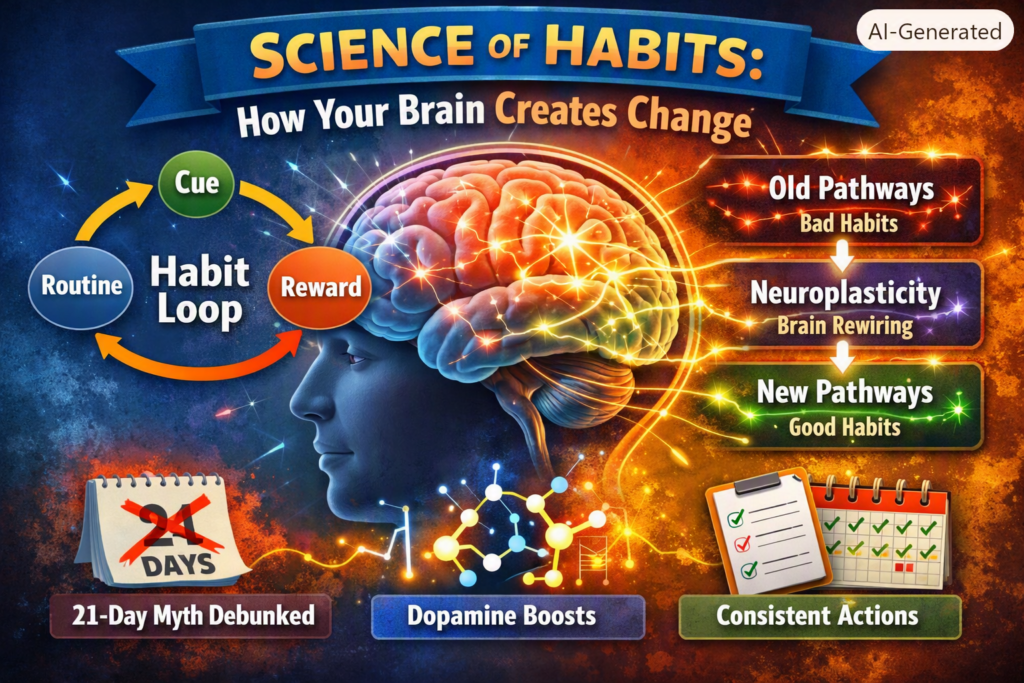
Science of Habits: How Your Brain Creates Change
Habits quietly shape the framework of our everyday existence. From brushing your teeth to checking your phone, these routines shape who you are and who you become. The science of habits: how your brain creates change reveals fascinating insights into why we repeat certain behaviors and how we can rewire them for success.
🧠 What Exactly Is a Habit?
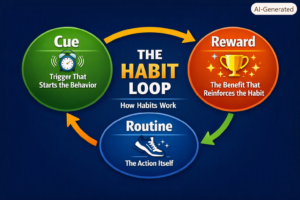
A habit is an automatic behavior triggered by cues in your environment. Your brain builds habits through repetition, saving energy by turning conscious actions into subconscious routines.
Cue → Trigger that starts the behavior
Routine → The action itself
Reward → The benefit that reinforces the habit
This loop, known as the habit cycle, explains why both good and bad habits stick.
🔬 Habit Formation Explained: The 21-Day Myth Debunked
You’ve probably heard the claim: “It takes 21 days to form a habit.” While catchy, science shows it’s not entirely true.
Research from University College London found that habit formation can take anywhere from 18 to 254 days, depending on complexity.
Simple habits (like drinking water after breakfast) form faster.
Complex habits (like exercising daily) require more time and consistency.
So, instead of chasing the 21‑day shortcut, focus on consistency and patience.
🧩 The Hidden Psychology Behind Everyday Habits
Everyday habits are deeply tied to psychology. Here’s how:
Dopamine Rewards: Your brain releases dopamine when you complete a habit, reinforcing the behavior.
Identity Connection: Habits tied to your self‑image (e.g., “I’m a runner”) are harder to break.
Environment Influence: Surroundings and social circles strongly impact which habits thrive.
Understanding the hidden psychology behind everyday habits helps you design routines that align with your goals.
⚡ How Your Brain Creates Change
Change begins with neuroplasticity—the brain’s ability to rewire itself. When you repeat a new behavior:
Neural pathways strengthen.
Old patterns weaken.
The new habit becomes automatic.
This process explains why persistence is key. Your brain literally reshapes itself to support new routines.
📈 Practical Tips to Build Better Habits
Start small: Focus on one habit at a time.
Use cues: Link new habits to existing routines.
Track progress: Journals or apps boost accountability.
Reward yourself: Positive reinforcement accelerates habit formation.
Adjust environment: Remove triggers for bad habits, add cues for good ones.
❓ FAQ Section
Q1: How long does it really take to form a habit?
It varies—anywhere from 18 to 254 days, depending on complexity.
Q2: Is the 21-day habit rule true?
No, it’s a myth. Science shows habit formation requires more time and consistency.
Q3: Why are bad habits so hard to break?
Because they’re tied to dopamine rewards and environmental cues that reinforce them.
Q4: Can habits change your identity?
Yes, habits linked to self‑image become part of your identity, making them stronger.
Q5: What’s the fastest way to build a new habit?
Start small, stay consistent, and use cues and rewards to reinforce the behavior.
🎯 Conclusion
The science of habits: how your brain creates change proves that transformation isn’t about quick fixes—it’s about consistency, psychology, and patience. By debunking the 21‑day myth and understanding the hidden psychology behind everyday habits, you can design routines that reshape your brain and redefine your future.